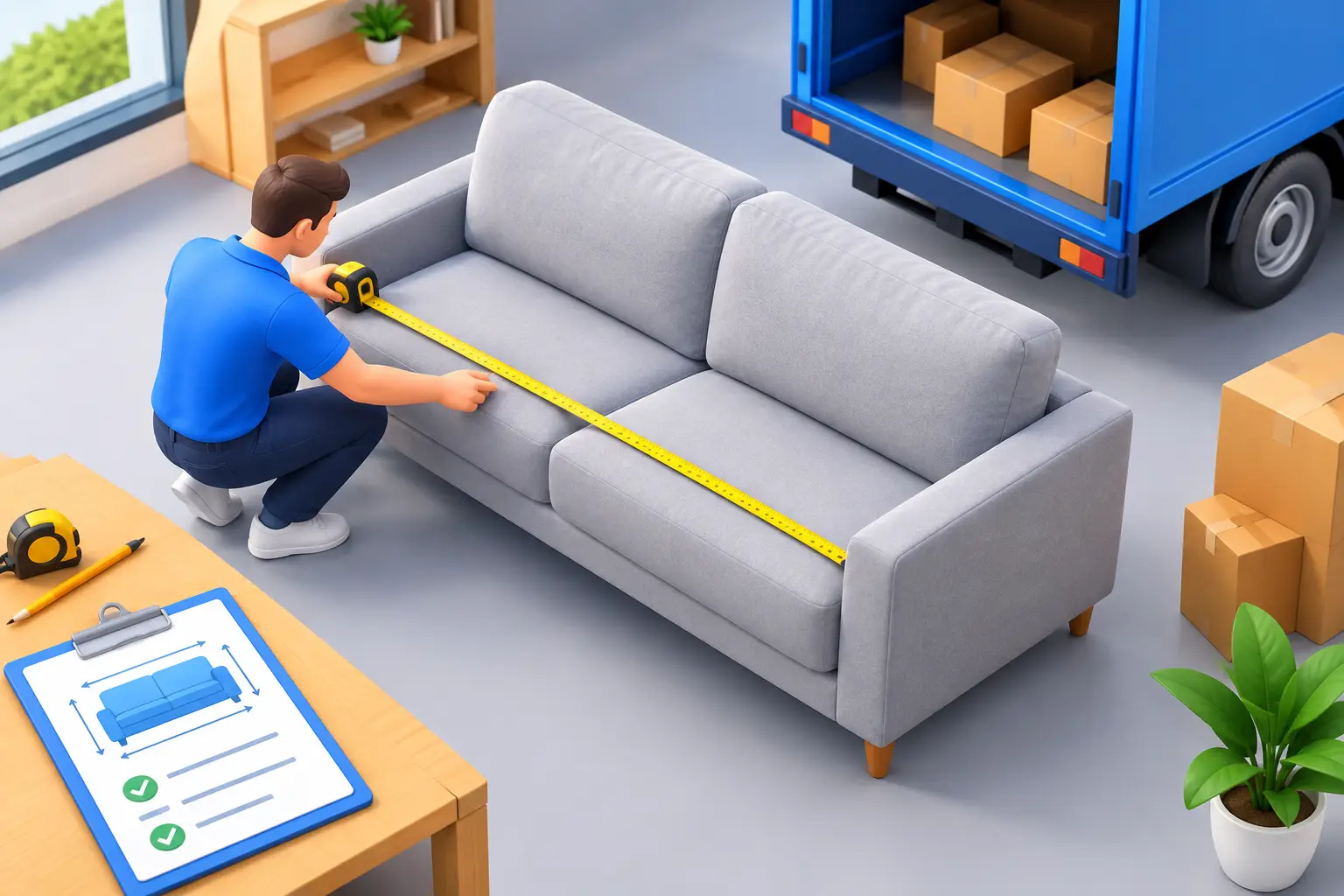
How to Measure Large Items Before Booking a Courier

A sofa that is only a few centimetres wider than expected can be the difference between a straightforward collection and a job that needs a larger vehicle or a different loading plan. The same applies to office desks, pallets, machinery parts and exhibition stands. Knowing how to measure large items before booking a courier gives you a clearer quote and helps ensure the right vehicle arrives.
For a dedicated delivery, accurate details help us plan collection, loading and direct transport from the start. You do not need specialist equipment. A tape measure, a few photographs and an honest description of the item are usually enough.
How to measure large items before booking a courier
Start by measuring the item at its widest, longest and tallest points. Record the dimensions in centimetres and use this order: length x width x height. For example, a boxed washing machine may measure 60cm x 65cm x 90cm, while a three-seat sofa may be 210cm x 95cm x 90cm.
Measure the item as it will be collected, not as you remember it from a product listing. Packaging can add significant size, particularly around white goods, furniture and fragile equipment. If an item has handles, legs, wheels, mirrors or fittings that stick out, include them in the measurement.
For irregular items, measure the furthest points in each direction. A bicycle, for example, may have handlebars that make it wider than its frame. A display unit may have a projecting base. It is better to allow a little extra space than understate the size.
If you are sending several items, measure each one separately. Then tell the courier how many there are, rather than only providing the overall total. Ten flat-packed boxes need a different loading arrangement from one large cabinet, even where the combined space is similar.
Use the outside measurements
Always provide external dimensions. A wardrobe's usable internal space or the screen size of a television does not tell us how much room it takes in a vehicle. Measure the full outer edge, including packaging and protective wrapping.
This is particularly relevant for televisions, appliances and glass-topped furniture. If you are using a box, measure after the item has been packed. If protective blankets or corner protection will be needed, mention this when requesting a quote so the load can be planned properly.
Measure items in the position they must travel
Some loads can travel flat, upright or on their side. Others cannot. A fridge or freezer may need to remain upright. A large framed picture, glass panel or screen may also need a particular position to reduce the risk of damage.
Tell the courier if the item has to stay upright, cannot be stacked on, or has a fragile side. These details affect how much usable room is available in the vehicle. A vehicle may have enough floor space for an item, but not enough height for it to stand safely.
Do not overlook weight
Dimensions decide whether an item fits. Weight helps determine how it can be loaded and whether extra care is needed at collection and delivery. You do not need to weigh every item precisely if that is not practical, but give the most accurate estimate you can.
Check a manufacturer label, product manual or retailer listing where available. For business consignments, a packing list may show the weight of each crate, component or pallet. If you are unsure, say so. A rough but realistic estimate is more useful than leaving weight out altogether.
Weight becomes especially important with machinery, engineering components, boxed stock, stone items and solid wood furniture. It also matters when an item needs to be carried through a building, up steps or along a narrow route.
Check the route at both ends
An item can fit in the van but still be difficult to collect or deliver if it cannot get through the door. Before booking, measure the narrowest parts of the route at both collection and destination. This might include doorways, lifts, communal entrances, stairwells, corridors, gates and tight turns.
For furniture, check the width and height of external doors as well as internal ones. For office equipment, consider whether it needs to pass through a reception area or service entrance. For construction materials, check whether there is a suitable place for the vehicle to stop and load safely.
You should also mention practical access details. Let the courier know if there are steps, restricted parking, a loading bay, a long walk from the vehicle, or someone on site who can direct the driver. These are not minor details. They help avoid wasted time and make the collection more straightforward.
Think about loading space, not just vehicle size
A vehicle is selected for the whole job, not simply the length of one item. The load may need room for secure positioning, protective materials and other consignments travelling with it. A long item may also need to be angled during loading, which can affect the space required.
This is why it helps to describe the item as well as sharing measurements. “One boxed treadmill, 210cm x 90cm x 45cm, approximately 100kg, collected from a ground-floor garage” gives a much clearer picture than “large gym equipment”.
For a pallet, provide its length, width and total height from the floor to the highest point. Include the pallet itself in the height. If cartons overhang the pallet or the load is not shrink-wrapped, say so. For long materials such as pipe, timber or display sections, give the full longest length and the quantity being moved.
Take useful photographs
Photographs can remove uncertainty, particularly where an item is awkwardly shaped or access is tight. Take a clear image of the item from a few angles, plus any relevant packaging. A photograph beside a tape measure can be helpful for unusual loads.
It is also useful to photograph a narrow doorway, stairs or the collection point if you think access may be difficult. This is not a replacement for dimensions, but it gives the courier context that numbers alone cannot provide.
Avoid sending photographs that show sensitive documents, customer information or security details. If an item is for a business site, a simple image of the load and its immediate access route is normally enough.
Give a complete description when requesting a quote
The best booking information is clear and practical. Alongside dimensions and estimated weight, explain what the item is, how many pieces are being moved, and whether it is boxed, wrapped, loose or on a pallet. Include the collection and delivery postcodes, preferred date, contact details at both ends and any access restrictions.
For urgent work, this lets the journey be assessed quickly. If you need an automotive part delivered to keep a repair moving, a laptop returned to a colleague, or production equipment taken to an event, accurate load details help us send a vehicle suited to the task.
For a sofa collection, white goods delivery, office relocation or small house move, it is worth listing every larger item rather than assuming they will all fit together. Smaller items can often be included, but they still take space and may need separate protection.
DB Couriers provides dedicated vehicles for collections and deliveries across the UK, so your consignment travels directly from collection to destination without being passed through sorting depots. Providing the right measurements helps us choose a suitable vehicle and give you a quote based on the job you actually need.
Common measuring mistakes to avoid
The most common mistake is measuring only the item itself and forgetting its packaging. The next is providing dimensions in the wrong order or mixing centimetres and metres. Keep every measurement in centimetres where possible, and label each figure clearly.
Another issue is estimating access from memory. If you are unsure whether a sofa will pass through a hallway or a crate will fit in a lift, measure it. A few minutes with a tape measure is easier than changing the collection plan on the day.
Finally, do not assume a large vehicle is automatically the right answer. A bigger vehicle may be necessary for a bulky load, but the ideal choice depends on dimensions, weight, access, the number of items and how they need to travel. Clear information allows the vehicle to be matched to the work.
When you are ready, send the item dimensions, weight estimate and access details with your collection and delivery locations. Request a free quote from DB Couriers and we will help you arrange transport that suits your load.
Comments